About the PODS Community
The Pipeline Open Data Standard (PODS) Association is a non‑profit, non-political member‑driven community that delivers the industry’s trusted pipeline data model, adopted by operators, service providers, vendors, and regulators worldwide. The PODS Standard—supported by an active, collaborative community—is the most effective and scalable foundation for building a GIS Digital Twin and modern pipeline data management program for now and the future. Since 1998, PODS has been adopted in 40 countries at 200+ Operators supporting over 3 Million miles of pipeline and systems.
Discover the Advantages of PODS
New to PODS? Check out this video for a quick baseline understanding of our Community and Data Models!
Write your awesome label here.
PODS Data Models: Organized Single Source of the Truth
The Pipeline Open Data Standard (PODS) data model provides the database architecture pipeline operators need to submit regulatory reports (PHMSA & TX RRC for example), store critical information, analyze pipeline systems data, and manage geospatial data in a linear-referenced database which can be visualized in any GIS platform. The PODS Pipeline Data Model houses the attribute, asset information, construction, inspection, integrity management, regulatory compliance, risk analysis, history, and operational data that pipeline companies have deemed mission-critical to successfully manage natural gas and hazardous liquids pipelines.
The PODS data model is the industry standard used by pipeline operators to provide a single master source of information and eliminate localized silos of often unconnected information. As the US and other parts of the world increase their focus on pipeline integrity management (PIM), the importance of data integration should not be overlooked. Referencing and integrating data within a spatial context can help to provide pipeline operators with a definitive view of their pipeline assets. The PODS data model provides guidelines for the tedious process of reconciling “as-built” data with operational and inspection data in one single source.
Because PODS is designed to rigid standards by the thought leaders in the pipeline industry, including operators and service providers from 39 countries, PODS can be accessed and used by multiple vendors and software platforms. PODS is already an extensive pipeline data model for storing a comprehensive set of critical features and attributes necessary to support PIM. PODS is GIS‐platform independent, meaning it can work with Esri, or any other GIS software.

PODS Design Standards
Database Architecture for a Linear-Referenced Database
The PODS Pipeline Data Model provides the database architecture pipeline operators use to store critical information organized for usability and analysis about their pipeline systems. It is paramount that this data is managed geospatially in a linear-referenced database which can then be visualized as a digital twin in any GIS platform.
This linear reference system incorporates location information with every record stored in the database. The ‘address’ or engineering station describes either a linear section of the pipeline or a point where that record applies.
In a similar manner, the same linear referencing system is used to locate, and effectively overlay, inspection reports, events, activities, or features, which occur on or near the pipeline. This is important for any operational, maintenance or field activity in that it promotes project prioritization, efficiencies and compliance to every regulation based on opportunistic field data capture.
PODS also allows for external documents such as reports, procurement records, hydrostatic test charts, or even photographs, to be linked to the physical assets they describe.
A Pipe-Centric Approach
The PODS Data Model was built for regulated pipeline and is continuously updated as new regulations are published. In fact, PHMSA is a PODS member and uses the model as a baseline for NPMS, so having your data in PODS is the easiest way for operators to submit their annual reports and NPMS uploads.
This pipe-centric approach to managing pipeline data in a single data repository, a PODS database, helps pipeline owners to collect, verify, manage, analyze, update, maintain, and deliver all the information about their pipelines quickly and reliably to applications and end-users. Since the data records are linked to the pipe segment, re-route, change of service, asset transfer or sale, abandonment, removal, repair, and replacement are all managed within the PODS database.
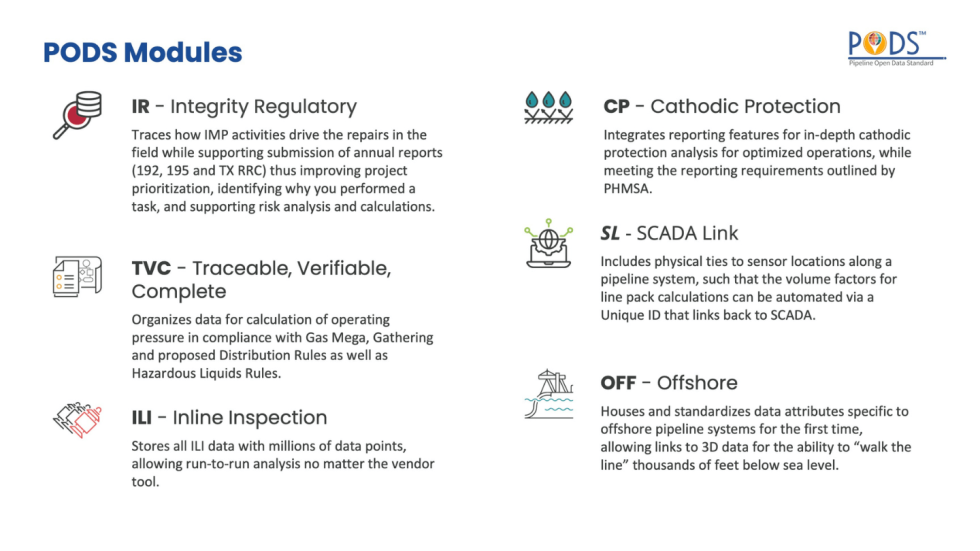
Our vision is to align more with the needs of operators, especially those who manage assets within various segments of the pipeline supply chain. PODS will now offer two core data models – PODS 7 APR and PODS 7 Utility Network. Both these core models will have the option to add to them regulatory and industry specific modules. With PODS standardizing on the core Esri Geodatabase, operators who have implemented the Esri Utility and Pipeline Data Model (UPDM) can also leverage these industry specific modules within their implementations.
A Repository for Mission-Critical Data
‘Open’ – A GIS Neutral –or– Esri Compatible Platform
Ultimate Pipeline Data Guideline
Why PODS is Important
The PODS Pipeline Data Model provides the database architecture pipeline operators use to store critical information.
Discover the difference of PODS 7 as compared to prior data model updates. Through the extensive work of our volunteers, PODS is now the most innovative and complete data model available.
PODS 7 lowers the risk, cost, and time required to implement a pipeline GIS. Maintaining a single pipeline data repository helps Pipeline Operators improve managed pipeline information quality, quantity, and timeliness.
PODS is an Open Standard, so you are not tied to a single vendor’s proprietary data model. Multiple vendors develop software products that interact with the PODS database, allowing you to choose software applications based on features, cost, and usability best suited for your company. Additionally, PODS is compatible with other data models, enhancing its flexibility and integration capabilities.
Discover the difference of PODS 7 as compared to prior data model updates. Through the extensive work of our volunteers, PODS is now the most innovative and complete data model available.
PODS 7 lowers the risk, cost, and time required to implement a pipeline GIS. Maintaining a single pipeline data repository helps Pipeline Operators improve managed pipeline information quality, quantity, and timeliness.
PODS is an Open Standard, so you are not tied to a single vendor’s proprietary data model. Multiple vendors develop software products that interact with the PODS database, allowing you to choose software applications based on features, cost, and usability best suited for your company. Additionally, PODS is compatible with other data models, enhancing its flexibility and integration capabilities.
Write your awesome label here.
Lesson seriesPODS
New PODS Modules, Focused on Integrity and Regulation: Opening the Model to More Pipeliners
The PODS Data Model was built for regulated pipeline and is continuously updated as new regulations are published. In fact, PHMSA is a PODS member and uses the model as a baseline for NPMS, so having your data in PODS is the easiest way for operators to submit their annual reports and NPMS uploads.
Our vision is to align more with the needs of operators, especially those who manage assets within various segments of the pipeline supply chain. PODS will now offer two core data models – PODS 7 APR and PODS 7 Utility Network.
Both core models will have the option to add to them regulatory and industry specific modules. With PODS standardizing on the core Esri Geodatabase, operators who have implemented the Esri Utility and Pipeline Data Model (UPDM) can also leverage these industry specific modules within their implementations.
Both core models will have the option to add to them regulatory and industry specific modules. With PODS standardizing on the core Esri Geodatabase, operators who have implemented the Esri Utility and Pipeline Data Model (UPDM) can also leverage these industry specific modules within their implementations.